MTG Reality Fracture: Jace’s Echoverse, Hexhaven Colleges, and the Biggest Alternate-Reality Twist in Magic
Meta Description: MTG Reality Fracture introduces Jace’s Echoverse, Hexhaven’s allied-color schools, alternate Chandra, new versions of Vraska, Liliana, Ajani, Garruk, and a major shift in Magic: The Gathering lore.
MTG Reality Fracture is not just another Magic: The Gathering set. It is a major lore event built around alternate realities, rewritten characters, and one of the game’s most famous Planeswalkers returning in a dangerous new role. At the center of it all is Jace Beleren, now known as The Theorist.
Reality Fracture introduces the Echoverse, an alternate universe created by Jace. This new reality contains alternate versions of planes and people, including some of Magic’s most iconic characters. The idea gives Wizards of the Coast a huge creative playground: familiar faces can return with new color identities, new histories, and new mechanical designs.
For players who enjoy Magic lore, alternate-art collectibles, Commander deck ideas, and bold set mechanics, Reality Fracture could be one of the most important releases in recent memory.
The Core Idea: What If Jace Rebuilt Reality?
Jace has always been connected to memory, thought, illusion, and control. Reality Fracture takes those themes to their extreme. Rather than simply reading minds or solving puzzles, Jace creates an entire alternate universe.
The Echoverse appears to be his attempt to reshape reality into something different. Maybe he wants to fix mistakes. Maybe he wants to protect someone. Maybe he believes he can improve the people and worlds around him. Whatever the reason, this is exactly the kind of story that can turn a powerful hero into a dangerous architect.
That is what makes the set exciting. Reality Fracture is not only about new cards. It is about the danger of rewriting lives. If Jace changes someone’s past to make them “better,” is that mercy, or is it control?
Hexhaven: The Echoverse Version of Strixhaven
The main setting of Reality Fracture is an alternate version of Arcavios. In regular Magic lore, Arcavios is home to Strixhaven, the famous magical university divided into five enemy-color colleges.
In the Echoverse, that school becomes Hexhaven. Instead of enemy-color pairings, Hexhaven is built around allied-color pairs. This one change creates a fresh identity while still keeping the magical academy structure that players already understand.
The five Hexhaven colleges are:
- Fatehold – blue-white, focused on Future History
- Theorix – blue-black, focused on Esoteric Mathematics
- Stingerquill – black-red, focused on Painful Words
- Konstrari – red-green, focused on Constructive Arts
- Vigorbloom – green-white, focused on Invasive Healing
These schools sound strange, stylish, and very Magic. They also open the door to new draft archetypes, Commander themes, and faction-based deck-building. Strixhaven fans will immediately understand the structure, but the allied-color twist gives the set its own personality.
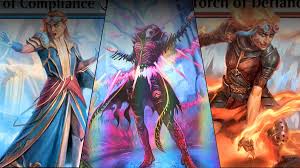
Chandra, Chill of Compliance Shows the Power of the Echoverse
The most important revealed example of an Echoverse character is Chandra, Chill of Compliance. In the main timeline, Chandra is defined by fire, emotion, rebellion, and explosive red mana. She is impulsive, passionate, and impossible to fully control.
In the Echoverse, Jace imagines a different Chandra. This version did not suffer the same early tragedy and did not unlock pyromancy in the same way. Instead of becoming a fiery rebel, she becomes calmer, colder, and more compliant.
This is exactly why Reality Fracture is interesting. The set is not just asking, “What color would Chandra be if she were different?” It is asking, “What pain made Chandra who she is, and what would be lost if that pain never happened?”
That makes the Echoverse emotionally complicated. A “better” version of a character might also be a less free version. Jace may be removing suffering, but he may also be removing identity.
More Iconic Characters Are Being Reimagined
Chandra is only the beginning. Wizards has also confirmed Echoverse versions of Vraska, Liliana, Ajani, and Garruk. These are major names, and each one carries years of lore, fan attachment, and mechanical identity.
Vraska’s inclusion is especially important because of her long relationship with Jace. If Reality Fracture is emotionally tied to Jace’s desires, regrets, or hopes, Vraska may be central to understanding why the Echoverse exists at all.
Liliana, Ajani, and Garruk also offer exciting design opportunities. Each character has a strong established identity, so seeing them color-shifted or emotionally rewritten could create some of the set’s most memorable cards.
The separate equipment card for Garruk’s axe is another exciting detail. It gives fans a long-awaited item card tied to one of Magic’s most recognizable hunters.
How Reality Fracture Avoids Breaking the Color Pie
Magic players are right to be cautious when a set starts changing colors and identities. The color pie is one of the game’s most important systems. If Wizards ignores it, the game can quickly feel unbalanced or thematically wrong.
Reality Fracture appears to be approaching this carefully. Instead of simply moving old cards into new colors, the design team is adjusting abilities to fit each new identity. A blue idea moved into red may lose blue-style card selection and gain red-style aggression. A black concept shifted into green-white may need to express itself through growth, healing, or board presence instead of sacrifice or death.
This makes the set more than a novelty. The best Echoverse cards should feel like believable alternate designs, not color-pie mistakes.
Why Collectors and Commander Players Should Pay Attention
Reality Fracture has strong collector appeal. Alternate versions of famous characters are always likely to attract attention, especially if the art, names, and mechanics clearly show how different these versions are from the originals.
Commander players may also find a lot to love. Color-shifted legendary characters can open deck-building options that did not exist before. A familiar character in a new color identity can inspire entirely new strategies.
The Echoverse sigil also gives the cards a distinct identity, making them easier to recognize as part of the set’s alternate reality.
A Major Story Moment for Magic
Reality Fracture is described as the conclusion of the story arc that began with Wilds of Eldraine, but it also feels like the beginning of something larger. The Echoverse gives Magic a new storytelling tool that could continue beyond this set.
If handled well, the Echoverse can let Wizards revisit classic ideas without resetting the main timeline. It can explore alternate character paths, strange versions of planes, and “what if?” designs that would not fit anywhere else.
Final Thoughts
Magic: The Gathering Reality Fracture looks like a bold, emotional, and mechanically ambitious set. Jace’s creation of the Echoverse gives Wizards a reason to transform familiar characters and locations while still telling a story with real stakes.
Hexhaven offers a clever twist on Strixhaven. Chandra’s new form shows how much identity can change when history is rewritten. The upcoming Echoverse versions of Vraska, Liliana, Ajani, and Garruk could become some of the set’s biggest highlights.
If Wizards balances creativity with color-pie discipline, Reality Fracture could become one of the most memorable MTG sets in years: a set about alternate worlds, painful choices, and the danger of believing one person can design a better reality.